Elections are supposed to be observable, auditable, and accountable.
In Nevada’s 2024 General Election, the State certified results that cannot arise in a fair election, then destroyed the very records required to verify them, while the courts enabled that destruction.
This is no longer a theory.
It is what the official record now shows.
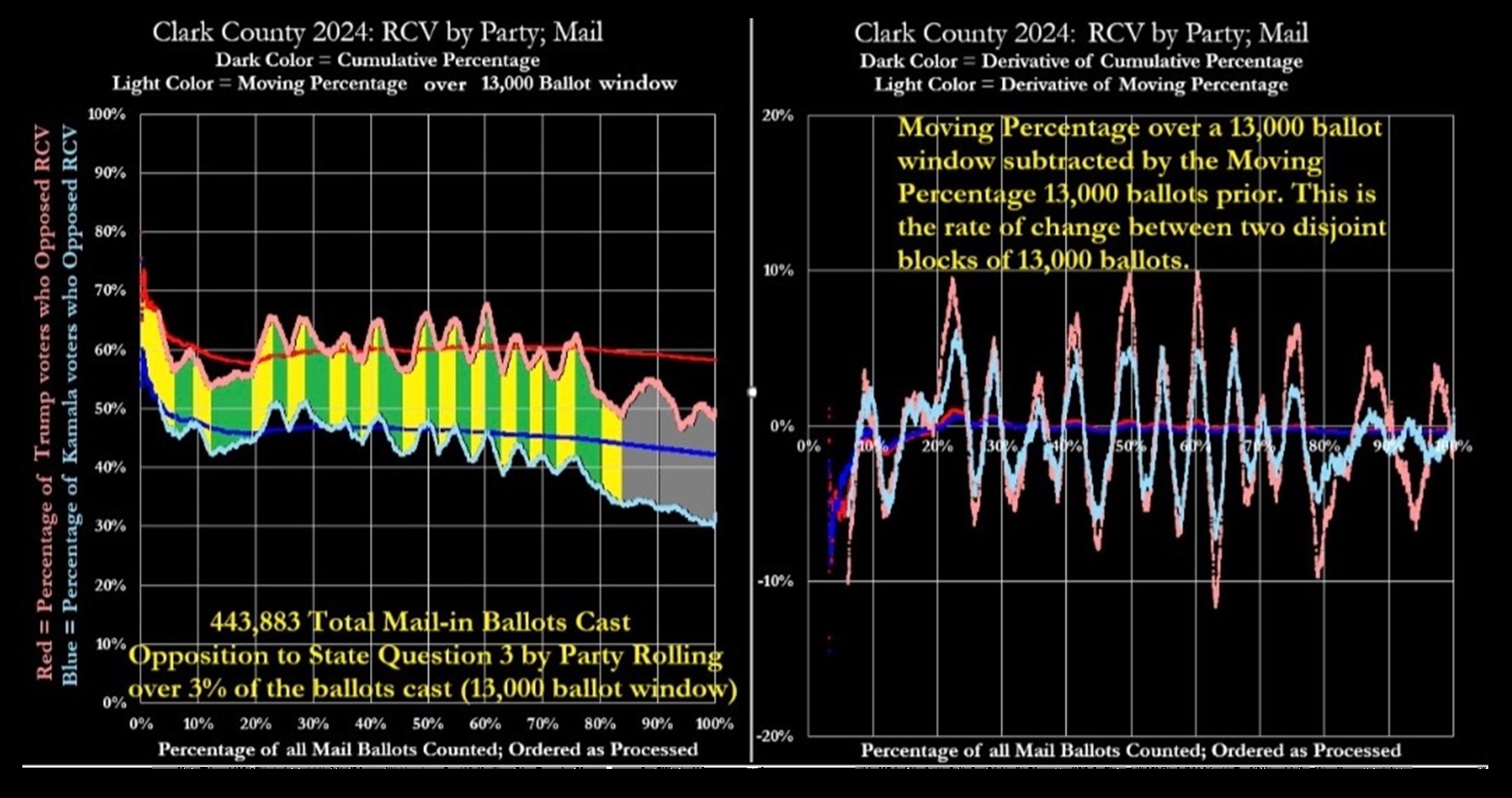
Nevada’s certified Cast Vote Record (CVR) displays statistical patterns so extreme they exceed a 12-sigma deviation — a probability on the order of one in a decillion.
Put simply:
The sequence of ballots certified by Clark County is mathematically incompatible with ordinary human voting behavior or logistical randomness.
In a fair election:
In Nevada’s CVR:
These patterns do not suggest voter preference.
They indicate structural interference with the vote-counting process itself.
Once litigation was underway—challenging both the statistical impossibility of the CVR and the legality of certification—the State did not preserve the evidence.
Instead, Nevada:
The State’s posture has been avoidance, not accountability.
Rather than confront erasure on the merits—what was overwritten, when, and under whose authorization—the defense avoided developing any adversarial record that could fix responsibility or preserve remaining artifacts. The result is predictable: the evidence disappears first, and the dispute is then framed as unprovable.
Courts exist to preserve rights when the political branches fail.
Here, the opposite occurred.
Emergency motions warning that evidence would be destroyed were denied.
Briefing was delayed past known destruction deadlines.
After the records were wiped, motions establishing spoliation were dismissed—without addressing the governing law.
The result was predictable and irreversible:
This is not mere error.
It is judicial enablement of evidentiary destruction in an election contest.
This case is not about parties or candidates.
It is about whether self-government is possible without verification.
An election that cannot be audited cannot be confirmed.
An election that cannot be confirmed cannot legitimately be certified.
And a system that destroys the evidence needed for voter oversight ceases to be republican in form.
The U.S. Constitution guarantees every state a Republican Form of Government.
That guarantee fails when:
That is not democracy with flaws.
That is the breakdown of constitutional self-rule.
The record—not allegations—shows that:
When an election cannot arise from a fair process,
and the evidence needed to test it is erased,
the conclusion is unavoidable:
The election was not fair.
Whether one uses the word rigged or not, the constitutional meaning is the same:
structured processes interfered with the vote count, and the people were denied their guaranteed role in self-government.
Filed Date and Document
Filed Date and Document